
How Deep Should Landscape Rock Be for Minnesota Yards
Landscape rock looks simple until it is too shallow, too deep, full of weeds, or spilling into the lawn after the first hard rain. In Minnesota, the right depth matters even more because rock beds deal with freeze-thaw cycles, spring runoff, heavy snow piles, and shifting soil.
For most residential rock beds, landscape rock should be 2 to 3 inches deep. Smaller rock usually needs less depth, while larger river rock often needs a little more coverage to sit well and look finished.

The best depth depends on the rock size
The most common answer to How Deep Should Landscape Rock Be is 2 to 3 inches, but rock size changes the details.
Rock type | Recommended depth | Best use |
Pea gravel | 2 inches | Walkways, small decorative areas, tight spaces |
1-inch river rock | 2 to 3 inches | Foundation beds, shrub beds, general landscaping |
1 1/2-inch river rock | 3 inches | Larger beds, drainage areas, low-maintenance borders |
2-inch to 3-inch cobble | 3 to 4 inches | Accent beds, slopes, drainage swales, high-visibility areas |
A shallow layer may expose fabric, soil, or old mulch. A layer that is too deep can swallow plants, trap debris, and make future maintenance harder.
For most rock beds Minnesota homeowners install around homes, patios, and trees, 3 inches is the safest target. It hides fabric well, stays in place better, and gives river rock landscaping a full, finished look.
Good rock installation starts before the rock arrives
The rock is the final layer, not the whole project. A clean, stable base makes the difference between a bed that looks good for years and one that needs fixing next season.
Start by removing old material. That includes faded mulch, mixed stone, weeds, leaves, and built-up soil near the edge. If old mulch is left underneath, it can break down, create uneven pockets, and hold moisture where it should not.
Next, shape the bed. A smooth grade helps water move away from the house instead of pooling near the foundation. In Minnesota yards, this is especially important after snowmelt and spring rain.
A basic prep process looks like this:
Remove old mulch, rock, weeds, and debris.
Cut a clean bed line.
Grade the soil so it drains properly.
Compact soft or disturbed areas by hand.
Keep soil and rock below siding, brick ledges, and weep holes.
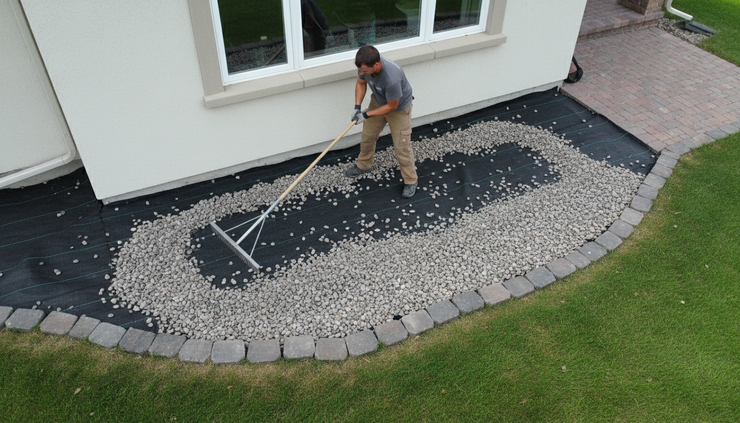
Install fabric and edging before spreading rock.
If the area has drainage problems, fix those before adding stone. Rock can help protect the surface, but it will not solve poor slope by itself. For bigger water issues, connect the rock bed plan with proper Drainage improvements.

Landscape fabric helps when it is installed correctly
Landscape fabric is not magic, but it does help separate rock from soil. That separation matters because rock slowly sinks when it sits directly on dirt, especially in areas with foot traffic, runoff, or soft soil.
Use quality fabric under decorative rock beds, especially around foundations, shrubs, and long borders. Overlap seams by several inches so weeds do not push through the gaps. Cut fabric neatly around plants, leaving enough room for stems and trunks to breathe.
Avoid plastic sheeting under rock beds. Plastic can trap water, block air, and create drainage problems. A woven or nonwoven landscape fabric allows water to pass through while keeping the rock layer cleaner.
Fabric works best when paired with enough rock depth. If rock is only 1 inch deep, fabric can show through after raking, wind, or snow shoveling. A 2 to 3 inch layer covers fabric much better.
Edging keeps rock where it belongs
Without edging, rock creeps into grass, mulch, sidewalks, and driveways. Snow removal, mowing, rain, and foot traffic all push stone out of place.
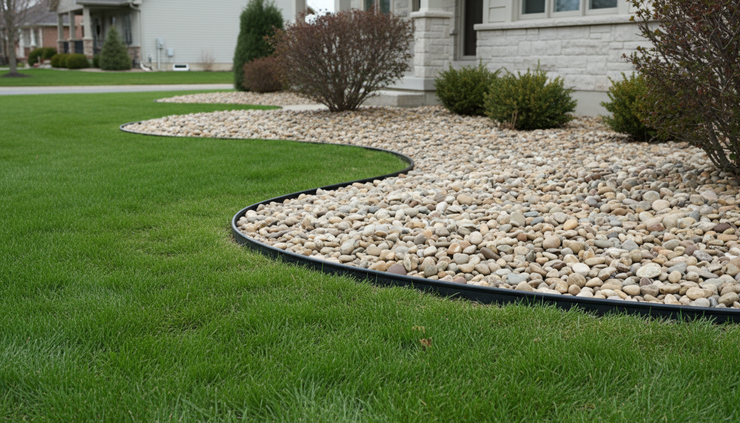
Good landscape edging creates a clean border and reduces weekly maintenance. It also helps hold a consistent rock depth across the bed.
Common edging options include:
Black poly or metal edging for clean curved beds.
Paver edging for a heavier, more decorative border.
Natural stone edging for a larger landscape renovation.
Concrete curbing for a permanent, defined edge.
The edge should sit high enough to contain the rock but not so high that it looks awkward or creates a tripping point. For most rock beds, install edging before spreading stone so the rock can be leveled against it.
For larger upgrades, it is often best to plan Landscaping, Rock Installation, Edging, and Landscape Renovations together instead of treating each part as a separate project.
How to calculate how much landscape rock you need
Rock is usually sold by the cubic yard or by the ton. Coverage depends on the depth, the type of stone, and how compactly it settles. The easiest way to estimate is to calculate cubic yards.
Use this formula:
Length × width × depth in feet ÷ 27 = cubic yards
For example, a bed that is 20 feet long and 6 feet wide is 120 square feet. At 3 inches deep, convert 3 inches to 0.25 feet.
120 × 0.25 ÷ 27 = 1.11 cubic yards
Add a little extra for curves, settling, and uneven areas. Do not over-order too much, though. Extra rock is heavy, hard to hide, and not easy to dispose of.
For irregular beds, break the area into smaller rectangles. Measure each section, add the totals, then calculate the depth.
Common mistakes with rock beds Minnesota homes should avoid
A rock bed can last a long time, but small shortcuts often create big maintenance problems.
The most common mistakes include:
Installing rock too shallow.
Skipping fabric in decorative beds.
Placing new rock over old mulch.
Ignoring drainage near the foundation.
Using no edging.
Burying plant crowns or tree trunks.
Choosing rock that is too small for slopes or runoff areas.
Spreading rock before weeds and roots are removed.
Putting new rock over old rock can work only if the old stone is clean, stable, and compatible in size and color. If the old layer is mixed with soil, mulch, weeds, or debris, remove it first. Otherwise, the new bed will look uneven and age faster.
The best size for river rock depends on the space. Around shrubs and foundations, 1 1/2-inch river rock is a strong all-purpose choice. Smaller stone is easier to walk on but can scatter. Larger stone stays put better but is harder to rake and install.
Quick answers about landscape rock depth
How many inches deep should landscape rock be?
Most beds should be 2 to 3 inches deep. Use 2 inches for smaller decorative stone and 3 inches for most river rock beds.
Do you need fabric under landscape rock?
Yes, in most decorative beds. Landscape fabric helps separate the rock from soil, slows weed growth, and keeps the bed cleaner.
Can you put new rock over old rock?
Only if the old rock is clean and stable. If it is mixed with mulch, dirt, weeds, or leaves, remove the old material first.
What size river rock is best?
For many Minnesota yards, 1 to 1 1/2-inch river rock works well. It covers fabric, stays in place, and looks natural around shrubs and foundations.
How much landscape rock do I need?
Measure the bed, choose your depth, then use: length × width × depth in feet ÷ 27. This gives you cubic yards.
JC Landscaping installs river rock, edging, landscape fabric, mulch, and complete landscape renovations throughout Ramsey, Andover, Maple Grove, Elk River, Otsego, Blaine, and the North Metro.
Call 763-242-0803 for an estimate.


Comments